KMP 实现鸿蒙跨端:团队管理工具 - 团队协作效率评估工具
本文介绍了一个基于Kotlin Multiplatform (KMP)的团队协作效率评估工具。该工具通过输入5项指标数据(沟通效率、任务协调、知识共享、团队凝聚力、工作效率),计算加权综合评分并生成详细分析报告。报告包含效率等级、最强/弱项评估和改进建议,支持多端复用(Node.js、Web、OpenHarmony)。Kotlin负责核心逻辑计算,ArkTS负责界面展示,体现了KMP"一
目录
- 概述
- 功能设计
- Kotlin 实现代码(KMP)
- JavaScript 调用示例
- ArkTS 页面集成与调用
- 数据输入与交互体验
- 编译与自动复制流程
- 总结
概述
本案例在 Kotlin Multiplatform (KMP) 工程中实现了一个 团队管理工具 - 团队协作效率评估工具:
- 输入:团队协作效率评估数据(沟通效率、任务协调、知识共享、团队凝聚力、工作效率),使用空格分隔,例如:
84 79 82 86 80。 - 输出:
- 效率基本信息:各项效率指标评分
- 效率分析:综合效率评分、效率等级、最强项、最弱项
- 效率评估:各项指标的详细评估
- 效率建议:根据分析结果的改进建议
- 团队管理策略:根据评估结果的管理策略
- 技术路径:Kotlin → Kotlin/JS → JavaScript 模块 → ArkTS 页面调用。
这个案例展示了 KMP 跨端开发在团队管理领域的应用:
把团队协作效率评估逻辑写在 Kotlin 里,一次实现,多端复用;把评估界面写在 ArkTS 里,专注 UI 和体验。
Kotlin 侧负责解析效率数据、计算效率指标、评估效率等级、生成改进建议;ArkTS 侧只需要把输入字符串传给 Kotlin 函数,并把返回结果原样展示出来即可。借助 KMP 的 Kotlin/JS 能力,这个团队协作效率评估工具可以在 Node.js、Web 前端以及 OpenHarmony 中复用相同的代码逻辑。
功能设计
输入数据格式
团队协作效率评估工具采用简单直观的输入格式:
- 使用 空格分隔 各个参数。
- 第一个参数是沟通效率(整数或浮点数,范围 0-100)。
- 第二个参数是任务协调(整数或浮点数,范围 0-100)。
- 第三个参数是知识共享(整数或浮点数,范围 0-100)。
- 第四个参数是团队凝聚力(整数或浮点数,范围 0-100)。
- 第五个参数是工作效率(整数或浮点数,范围 0-100)。
- 输入示例:
84 79 82 86 80
这可以理解为:
- 沟通效率:84 分
- 任务协调:79 分
- 知识共享:82 分
- 团队凝聚力:86 分
- 工作效率:80 分
工具会基于这些数据计算出:
- 综合效率评分:所有效率指标的加权平均值
- 效率等级:根据综合效率评分的等级评估
- 最强项:效率指标中表现最好的方面
- 最弱项:效率指标中表现最差的方面
- 效率差距:最强项和最弱项的差异
输出信息结构
为了便于在 ArkTS 页面以及终端中直接展示,Kotlin 函数返回的是一段结构化的多行文本,划分为几个分区:
- 标题区:例如"👥 团队协作效率评估",一眼看出工具用途。
- 效率基本信息:各项效率指标评分。
- 效率分析:综合效率评分、效率等级、最强项、最弱项。
- 效率评估:各项指标的详细评估。
- 效率建议:根据分析结果的改进建议。
- 团队管理策略:根据评估结果的管理策略。
这样的输出结构使得:
- 在 ArkTS 中可以直接把整段文本绑定到
Text组件,配合monospace字体,阅读体验类似终端报告。 - 如果将来想把结果保存到日志或者后端,直接保存字符串即可。
- 需要更精细的 UI 时,也可以在前端根据分隔符进行拆分,再按块展示。
Kotlin 实现代码(KMP)
核心代码在 src/jsMain/kotlin/App.kt 中,通过 @JsExport 导出。以下是完整的 Kotlin 实现:
@OptIn(ExperimentalJsExport::class)
@JsExport
fun teamCollaborationEfficiencyAnalyzer(inputData: String = "84 79 82 86 80"): String {
    // 输入格式: 沟通效率 任务协调 知识共享 团队凝聚力 工作效率
    val parts = inputData.trim().split(" ").filter { it.isNotEmpty() }

    if (parts.size < 5) {
        return "❌ 错误: 请输入完整的信息,格式: 沟通效率 任务协调 知识共享 团队凝聚力 工作效率\n例如: 84 79 82 86 80"
    }

    val communicationEfficiency = parts[0].toDoubleOrNull() ?: return "❌ 错误: 沟通效率必须是数字"
    val taskCoordination = parts[1].toDoubleOrNull() ?: return "❌ 错误: 任务协调必须是数字"
    val knowledgeSharing = parts[2].toDoubleOrNull() ?: return "❌ 错误: 知识共享必须是数字"
    val teamCohesion = parts[3].toDoubleOrNull() ?: return "❌ 错误: 团队凝聚力必须是数字"
    val workEfficiency = parts[4].toDoubleOrNull() ?: return "❌ 错误: 工作效率必须是数字"

    if (communicationEfficiency < 0 || communicationEfficiency > 100) {
        return "❌ 错误: 沟通效率必须在 0-100 之间"
    }

    if (taskCoordination < 0 || taskCoordination > 100) {
        return "❌ 错误: 任务协调必须在 0-100 之间"
    }

    if (knowledgeSharing < 0 || knowledgeSharing > 100) {
        return "❌ 错误: 知识共享必须在 0-100 之间"
    }

    if (teamCohesion < 0 || teamCohesion > 100) {
        return "❌ 错误: 团队凝聚力必须在 0-100 之间"
    }

    if (workEfficiency < 0 || workEfficiency > 100) {
        return "❌ 错误: 工作效率必须在 0-100 之间"
    }

    // 计算加权综合效率评分
    val comprehensiveEfficiency = (communicationEfficiency * 0.25 + taskCoordination * 0.25 + knowledgeSharing * 0.20 + teamCohesion * 0.15 + workEfficiency * 0.15)

    // 判断效率等级
    val efficiencyLevel = when {
        comprehensiveEfficiency >= 85 -> "⭐⭐⭐⭐⭐ 优秀"
        comprehensiveEfficiency >= 75 -> "⭐⭐⭐⭐ 良好"
        comprehensiveEfficiency >= 65 -> "⭐⭐⭐ 中等"
        comprehensiveEfficiency >= 55 -> "⭐⭐ 一般"
        else -> "⭐ 需要改进"
    }

    // 找出最强和最弱项
    val efficiencyItems = mapOf(
        "沟通效率" to communicationEfficiency,
        "任务协调" to taskCoordination,
        "知识共享" to knowledgeSharing,
        "团队凝聚力" to teamCohesion,
        "工作效率" to workEfficiency
    )

    val strongest = efficiencyItems.maxByOrNull { it.value }
    val weakest = efficiencyItems.minByOrNull { it.value }

    // 判断各项效率等级
    val getEfficiencyGrade = { score: Double ->
        when {
            score >= 85 -> "优秀"
            score >= 75 -> "良好"
            score >= 65 -> "中等"
            score >= 55 -> "一般"
            else -> "需要改进"
        }
    }

    // 生成效率分析
    val efficiencyAnalysis = StringBuilder()
    efficiencyAnalysis.append("• 沟通效率: ${String.format("%.1f", communicationEfficiency)} 分 (${getEfficiencyGrade(communicationEfficiency)})\n")
    efficiencyAnalysis.append("• 任务协调: ${String.format("%.1f", taskCoordination)} 分 (${getEfficiencyGrade(taskCoordination)})\n")
    efficiencyAnalysis.append("• 知识共享: ${String.format("%.1f", knowledgeSharing)} 分 (${getEfficiencyGrade(knowledgeSharing)})\n")
    efficiencyAnalysis.append("• 团队凝聚力: ${String.format("%.1f", teamCohesion)} 分 (${getEfficiencyGrade(teamCohesion)})\n")
    efficiencyAnalysis.append("• 工作效率: ${String.format("%.1f", workEfficiency)} 分 (${getEfficiencyGrade(workEfficiency)})\n")

    // 生成改进建议
    val improvementAdvice = StringBuilder()
    if (communicationEfficiency < 75) {
        improvementAdvice.append("• 沟通效率需改进: 建议加强团队沟通,建立有效的沟通机制\n")
    }
    if (taskCoordination < 75) {
        improvementAdvice.append("• 任务协调需改进: 建议优化任务分配,提高协调能力\n")
    }
    if (knowledgeSharing < 75) {
        improvementAdvice.append("• 知识共享需改进: 建议建立知识共享平台,促进经验交流\n")
    }
    if (teamCohesion < 75) {
        improvementAdvice.append("• 团队凝聚力需改进: 建议加强团队建设,提高团队凝聚力\n")
    }
    if (workEfficiency < 75) {
        improvementAdvice.append("• 工作效率需改进: 建议优化工作流程,提高工作效率\n")
    }
    if (improvementAdvice.isEmpty()) {
        improvementAdvice.append("• 团队协作效率良好,继续维护\n")
    }

    // 生成效率建议
    val efficiencyAdvice = when {
        comprehensiveEfficiency >= 85 -> "团队协作效率优秀,建议作为标杆团队,推广经验。"
        comprehensiveEfficiency >= 75 -> "团队协作效率良好,建议继续优化,争取更好成绩。"
        comprehensiveEfficiency >= 65 -> "团队协作效率中等,建议加强管理,提高执行力。"
        comprehensiveEfficiency >= 55 -> "团队协作效率一般,建议制定改进计划,重点突破。"
        else -> "团队协作效率需要改进,建议进行深入分析,制定改善方案。"
    }

    // 生成管理策略
    val managementStrategy = when {
        comprehensiveEfficiency >= 75 -> "建议加强团队管理,保持高效率水平"
        comprehensiveEfficiency >= 65 -> "建议定期进行效率评估,持续改进"
        else -> "建议制定效率改进计划,明确改进目标"
    }

    // 构建输出文本
    val result = StringBuilder()
    result.append("👥 团队协作效率评估\n")
    result.append("═".repeat(60)).append("\n\n")

    result.append("📊 效率基本信息\n")
    result.append("─".repeat(60)).append("\n")
    result.append("沟通效率: ${String.format("%.1f", communicationEfficiency)} 分\n")
    result.append("任务协调: ${String.format("%.1f", taskCoordination)} 分\n")
    result.append("知识共享: ${String.format("%.1f", knowledgeSharing)} 分\n")
    result.append("团队凝聚力: ${String.format("%.1f", teamCohesion)} 分\n")
    result.append("工作效率: ${String.format("%.1f", workEfficiency)} 分\n\n")

    result.append("📈 效率分析\n")
    result.append("─".repeat(60)).append("\n")
    result.append("综合效率评分: ${String.format("%.1f", comprehensiveEfficiency)}/100\n")
    result.append("效率等级: ${efficiencyLevel}\n")
    result.append("最强项: ${strongest?.key} (${String.format("%.1f", strongest?.value ?: 0.0)} 分)\n")
    result.append("最弱项: ${weakest?.key} (${String.format("%.1f", weakest?.value ?: 0.0)} 分)\n")
    result.append("效率差距: ${String.format("%.1f", (strongest?.value ?: 0.0) - (weakest?.value ?: 0.0))} 分\n\n")

    result.append("🔍 效率评估\n")
    result.append("─".repeat(60)).append("\n")
    result.append(efficiencyAnalysis.toString()).append("\n")

    result.append("💡 改进建议\n")
    result.append("─".repeat(60)).append("\n")
    result.append(improvementAdvice.toString()).append("\n")

    result.append("🎯 效率建议\n")
    result.append("─".repeat(60)).append("\n")
    result.append("${efficiencyAdvice}\n\n")

    result.append("📋 管理策略\n")
    result.append("─".repeat(60)).append("\n")
    result.append("${managementStrategy}\n\n")

    result.append("📋 团队管理建议\n")
    result.append("─".repeat(60)).append("\n")
    result.append("1. 建立团队协作效率监测体系,定期评估\n")
    result.append("2. 建立有效的沟通机制,提高沟通效率\n")
    result.append("3. 优化任务分配流程,提高任务协调\n")
    result.append("4. 建立知识共享平台,促进经验交流\n")
    result.append("5. 加强团队建设,提高团队凝聚力\n")
    result.append("6. 优化工作流程,提高工作效率\n")
    result.append("7. 建立团队激励机制,提高工作动力\n")
    result.append("8. 定期进行团队活动,增强团队凝聚力\n")
    result.append("9. 建立反馈机制,及时发现问题\n")
    result.append("10. 制定团队发展计划,持续改进\n\n")

    result.append("🔧 效率改进方法\n")
    result.append("─".repeat(60)).append("\n")
    result.append("• 沟通优化: 建立有效的沟通渠道和机制\n")
    result.append("• 任务管理: 优化任务分配和跟踪流程\n")
    result.append("• 知识管理: 建立知识库,促进知识共享\n")
    result.append("• 团队建设: 加强团队活动,提高凝聚力\n")
    result.append("• 流程优化: 简化工作流程,提高效率\n")
    result.append("• 工具应用: 引入协作工具,提高协作效率\n")
    result.append("• 培训发展: 加强员工培训,提高能力\n")
    result.append("• 文化建设: 建立积极的团队文化\n\n")

    result.append("⚖️ 效率等级标准\n")
    result.append("─".repeat(60)).append("\n")
    result.append("• 优秀 (85-100分): 团队协作效率优秀,可作为标杆\n")
    result.append("• 良好 (75-84分): 团队协作效率良好,需继续维护\n")
    result.append("• 中等 (65-74分): 团队协作效率中等,需加强改进\n")
    result.append("• 一般 (55-64分): 团队协作效率一般,需重点改善\n")
    result.append("• 需要改进 (0-54分): 团队协作效率不理想,需立即改善\n")

    return result.toString()
}
代码说明
这段 Kotlin 代码实现了完整的团队协作效率评估和改进建议功能。让我详细解释关键部分:
数据验证:首先验证输入的效率数据是否有效,确保数据在 0-100 范围内。
评分计算:采用加权平均方式计算综合效率评分,其中沟通效率占25%,任务协调占25%,知识共享占20%,团队凝聚力占15%,工作效率占15%。
等级评估:根据综合效率评分给出相应的效率等级。
项目分析:找出最强项和最弱项,计算两者的差距,帮助识别改进方向。
建议生成:根据各项指标生成个性化的改进建议和管理策略。
JavaScript 调用示例
编译后的 JavaScript 代码可以在 Node.js 或浏览器中直接调用。以下是 JavaScript 的使用示例:
// 导入编译后的 Kotlin/JS 模块
const { teamCollaborationEfficiencyAnalyzer } = require('./hellokjs.js');

// 示例 1:优秀
const result1 = teamCollaborationEfficiencyAnalyzer("84 79 82 86 80");
console.log("示例 1 - 优秀:");
console.log(result1);
console.log("\n");

// 示例 2:良好
const result2 = teamCollaborationEfficiencyAnalyzer("80 75 78 82 76");
console.log("示例 2 - 良好:");
console.log(result2);
console.log("\n");

// 示例 3:中等
const result3 = teamCollaborationEfficiencyAnalyzer("70 65 68 72 66");
console.log("示例 3 - 中等:");
console.log(result3);
console.log("\n");

// 示例 4:一般
const result4 = teamCollaborationEfficiencyAnalyzer("60 55 58 62 56");
console.log("示例 4 - 一般:");
console.log(result4);
console.log("\n");

// 示例 5:需要改进
const result5 = teamCollaborationEfficiencyAnalyzer("50 45 48 52 46");
console.log("示例 5 - 需要改进:");
console.log(result5);
console.log("\n");

// 示例 6:使用默认参数
const result6 = teamCollaborationEfficiencyAnalyzer();
console.log("示例 6 - 使用默认参数:");
console.log(result6);

// 实际应用场景:从用户输入获取数据
function analyzeTeamEfficiency(userInput) {
    try {
        const result = teamCollaborationEfficiencyAnalyzer(userInput);
        return {
            success: true,
            data: result
        };
    } catch (error) {
        return {
            success: false,
            error: error.message
        };
    }
}

// 测试实际应用
const userInput = "88 82 85 88 84";
const analysis = analyzeTeamEfficiency(userInput);
if (analysis.success) {
    console.log("团队协作效率分析结果:");
    console.log(analysis.data);
} else {
    console.log("分析失败:", analysis.error);
}

// 多个团队协作效率对比
function compareTeamEfficiency(teams) {
    console.log("\n多个团队协作效率对比:");
    console.log("═".repeat(60));

    const results = teams.map((team, index) => {
        const analysis = teamCollaborationEfficiencyAnalyzer(team);
        return {
            number: index + 1,
            team,
            analysis
        };
    });

    results.forEach(result => {
        console.log(`\n团队 ${result.number} (${result.team}):`);
        console.log(result.analysis);
    });

    return results;
}

// 测试多个团队协作效率对比
const teams = [
    "84 79 82 86 80",
    "80 75 78 82 76",
    "70 65 68 72 66",
    "60 55 58 62 56"
];

compareTeamEfficiency(teams);

// 团队协作效率统计分析
function analyzeTeamStats(teams) {
    const data = teams.map(team => {
        const parts = team.split(' ').map(Number);
        return {
            communication: parts[0],
            coordination: parts[1],
            sharing: parts[2],
            cohesion: parts[3],
            efficiency: parts[4]
        };
    });

    console.log("\n团队协作效率统计分析:");
    const avgCommunication = data.reduce((sum, d) => sum + d.communication, 0) / data.length;
    const avgCoordination = data.reduce((sum, d) => sum + d.coordination, 0) / data.length;
    const avgSharing = data.reduce((sum, d) => sum + d.sharing, 0) / data.length;
    const avgCohesion = data.reduce((sum, d) => sum + d.cohesion, 0) / data.length;
    const avgEfficiency = data.reduce((sum, d) => sum + d.efficiency, 0) / data.length;

    console.log(`平均沟通效率: ${avgCommunication.toFixed(1)}`);
    console.log(`平均任务协调: ${avgCoordination.toFixed(1)}`);
    console.log(`平均知识共享: ${avgSharing.toFixed(1)}`);
    console.log(`平均团队凝聚力: ${avgCohesion.toFixed(1)}`);
    console.log(`平均工作效率: ${avgEfficiency.toFixed(1)}`);
    console.log(`平均综合效率: ${((avgCommunication * 0.25 + avgCoordination * 0.25 + avgSharing * 0.20 + avgCohesion * 0.15 + avgEfficiency * 0.15)).toFixed(1)}`);
}

analyzeTeamStats(teams);
JavaScript 代码说明
这段 JavaScript 代码展示了如何在 Node.js 环境中调用编译后的 Kotlin 函数。关键点包括:
模块导入:使用 require 导入编译后的 JavaScript 模块,获取导出的 teamCollaborationEfficiencyAnalyzer 函数。
多个示例:展示了不同效率等级的调用方式,包括优秀、良好、中等、一般、需要改进等。
错误处理:在实际应用中,使用 try-catch 块来处理可能的错误。
多团队对比:compareTeamEfficiency 函数展示了如何对比多个团队的协作效率。
统计分析:analyzeTeamStats 函数演示了如何进行团队协作效率统计分析。
ArkTS 页面集成与调用
在 OpenHarmony 的 ArkTS 页面中集成这个团队协作效率评估工具。以下是完整的 ArkTS 实现代码:
import { teamCollaborationEfficiencyAnalyzer } from './hellokjs';

@Entry
@Component
struct TeamCollaborationEfficiencyAnalyzerPage {
  @State communicationEfficiency: string = "84";
  @State taskCoordination: string = "79";
  @State knowledgeSharing: string = "82";
  @State teamCohesion: string = "86";
  @State workEfficiency: string = "80";
  @State analysisResult: string = "";
  @State isLoading: boolean = false;

  build() {
    Column() {
      // 顶部栏
      Row() {
        Text("👥 团队协作效率评估")
          .fontSize(24)
          .fontWeight(FontWeight.Bold)
          .fontColor(Color.White)
      }
      .width("100%")
      .height(60)
      .backgroundColor("#00838F")
      .justifyContent(FlexAlign.Center)
      .padding({ top: 10, bottom: 10 })

      // 主容器
      Scroll() {
        Column() {
          // 沟通效率输入
          Text("沟通效率 (0-100)")
            .fontSize(14)
            .fontColor("#333333")
            .margin({ top: 20, left: 15 })

          TextInput({
            placeholder: "例如: 84",
            text: this.communicationEfficiency
          })
            .width("90%")
            .height(45)
            .margin({ top: 8, bottom: 15, left: 15, right: 15 })
            .padding({ left: 10, right: 10 })
            .backgroundColor("#B2EBF2")
            .border({ width: 1, color: "#00838F" })
            .onChange((value: string) => {
              this.communicationEfficiency = value;
            })

          // 任务协调输入
          Text("任务协调 (0-100)")
            .fontSize(14)
            .fontColor("#333333")
            .margin({ left: 15 })

          TextInput({
            placeholder: "例如: 79",
            text: this.taskCoordination
          })
            .width("90%")
            .height(45)
            .margin({ top: 8, bottom: 15, left: 15, right: 15 })
            .padding({ left: 10, right: 10 })
            .backgroundColor("#B2EBF2")
            .border({ width: 1, color: "#00838F" })
            .onChange((value: string) => {
              this.taskCoordination = value;
            })

          // 知识共享输入
          Text("知识共享 (0-100)")
            .fontSize(14)
            .fontColor("#333333")
            .margin({ left: 15 })

          TextInput({
            placeholder: "例如: 82",
            text: this.knowledgeSharing
          })
            .width("90%")
            .height(45)
            .margin({ top: 8, bottom: 15, left: 15, right: 15 })
            .padding({ left: 10, right: 10 })
            .backgroundColor("#B2EBF2")
            .border({ width: 1, color: "#00838F" })
            .onChange((value: string) => {
              this.knowledgeSharing = value;
            })

          // 团队凝聚力输入
          Text("团队凝聚力 (0-100)")
            .fontSize(14)
            .fontColor("#333333")
            .margin({ left: 15 })

          TextInput({
            placeholder: "例如: 86",
            text: this.teamCohesion
          })
            .width("90%")
            .height(45)
            .margin({ top: 8, bottom: 15, left: 15, right: 15 })
            .padding({ left: 10, right: 10 })
            .backgroundColor("#B2EBF2")
            .border({ width: 1, color: "#00838F" })
            .onChange((value: string) => {
              this.teamCohesion = value;
            })

          // 工作效率输入
          Text("工作效率 (0-100)")
            .fontSize(14)
            .fontColor("#333333")
            .margin({ left: 15 })

          TextInput({
            placeholder: "例如: 80",
            text: this.workEfficiency
          })
            .width("90%")
            .height(45)
            .margin({ top: 8, bottom: 15, left: 15, right: 15 })
            .padding({ left: 10, right: 10 })
            .backgroundColor("#B2EBF2")
            .border({ width: 1, color: "#00838F" })
            .onChange((value: string) => {
              this.workEfficiency = value;
            })

          // 按钮区域
          Row() {
            Button("📊 分析效率")
              .width("45%")
              .height(45)
              .backgroundColor("#00838F")
              .fontColor(Color.White)
              .fontSize(16)
              .fontWeight(FontWeight.Bold)
              .onClick(() => {
                this.isLoading = true;
                setTimeout(() => {
                  const input = `${this.communicationEfficiency} ${this.taskCoordination} ${this.knowledgeSharing} ${this.teamCohesion} ${this.workEfficiency}`;
                  this.analysisResult = teamCollaborationEfficiencyAnalyzer(input);
                  this.isLoading = false;
                }, 300);
              })

            Blank()

            Button("🔄 重置")
              .width("45%")
              .height(45)
              .backgroundColor("#2196F3")
              .fontColor(Color.White)
              .fontSize(16)
              .fontWeight(FontWeight.Bold)
              .onClick(() => {
                this.communicationEfficiency = "84";
                this.taskCoordination = "79";
                this.knowledgeSharing = "82";
                this.teamCohesion = "86";
                this.workEfficiency = "80";
                this.analysisResult = "";
                this.isLoading = false;
              })
          }
          .width("90%")
          .margin({ top: 10, bottom: 20, left: 15, right: 15 })
          .justifyContent(FlexAlign.SpaceBetween)

          // 加载指示器
          if (this.isLoading) {
            Row() {
              LoadingProgress()
                .width(40)
                .height(40)
                .color("#00838F")
              Text("  正在分析中...")
                .fontSize(14)
                .fontColor("#666666")
            }
            .width("90%")
            .height(50)
            .margin({ bottom: 15, left: 15, right: 15 })
            .justifyContent(FlexAlign.Center)
            .backgroundColor("#B2EBF2")
            .borderRadius(8)
          }

          // 结果显示区域
          if (this.analysisResult.length > 0) {
            Column() {
              Text("📋 分析结果")
                .fontSize(16)
                .fontWeight(FontWeight.Bold)
                .fontColor("#00838F")
                .margin({ bottom: 10 })

              Text(this.analysisResult)
                .width("100%")
                .fontSize(12)
                .fontFamily("monospace")
                .fontColor("#333333")
                .lineHeight(1.6)
                .padding(10)
                .backgroundColor("#FAFAFA")
                .border({ width: 1, color: "#E0E0E0" })
                .borderRadius(8)
            }
            .width("90%")
            .margin({ top: 20, bottom: 30, left: 15, right: 15 })
            .padding(15)
            .backgroundColor("#B2EBF2")
            .borderRadius(8)
            .border({ width: 1, color: "#00838F" })
          }
        }
        .width("100%")
      }
      .layoutWeight(1)
      .backgroundColor("#FFFFFF")
    }
    .width("100%")
    .height("100%")
    .backgroundColor("#F5F5F5")
  }
}
ArkTS 代码说明
这段 ArkTS 代码实现了完整的用户界面和交互逻辑。关键点包括:
导入函数:从编译后的 JavaScript 模块中导入 teamCollaborationEfficiencyAnalyzer 函数。
状态管理:使用 @State 装饰器管理七个状态:沟通效率、任务协调、知识共享、团队凝聚力、工作效率、分析结果和加载状态。
UI 布局:包含顶部栏、五个输入框、分析效率和重置按钮、加载指示器和结果显示区域。
交互逻辑:用户输入效率评分后,点击分析效率按钮。应用会调用 Kotlin 函数进行分析,显示加载动画,最后展示详细的分析结果。
样式设计:使用青色主题,与团队协作和效率相关的主题相符。所有输入框、按钮和结果显示区域都有相应的样式设置。
数据输入与交互体验
输入数据格式规范
为了确保工具能够正确处理用户输入,用户应该遵循以下规范:
- 沟通效率:整数或浮点数,范围 0-100。
- 任务协调:整数或浮点数,范围 0-100。
- 知识共享:整数或浮点数,范围 0-100。
- 团队凝聚力:整数或浮点数,范围 0-100。
- 工作效率:整数或浮点数,范围 0-100。
- 分隔符:使用空格分隔各个参数。
示例输入
- 优秀:
84 79 82 86 80 - 良好:
80 75 78 82 76 - 中等:
70 65 68 72 66 - 一般:
60 55 58 62 56 - 需要改进:
50 45 48 52 46
交互流程
- 用户打开应用,看到输入框和默认数据
- 用户输入五项效率评分
- 点击"分析效率"按钮,应用调用 Kotlin 函数进行分析
- 应用显示加载动画,表示正在处理
- 分析完成后,显示详细的分析结果,包括效率分析、建议等
- 用户可以点击"重置"按钮清空数据,重新开始
编译与自动复制流程
编译步骤
-
编译 Kotlin 代码:
./gradlew build -
生成 JavaScript 文件:
编译过程会自动生成hellokjs.d.ts和hellokjs.js文件。 -
复制到 ArkTS 项目:
使用提供的脚本自动复制生成的文件到 ArkTS 项目的 pages 目录:./build-and-copy.bat
文件结构
编译完成后,项目结构如下:
kmp_openharmony/
├── src/
│   └── jsMain/
│       └── kotlin/
│           └── App.kt (包含 teamCollaborationEfficiencyAnalyzer 函数)
├── build/
│   └── js/
│       └── packages/
│           └── hellokjs/
│               ├── hellokjs.d.ts
│               └── hellokjs.js
└── kmp_ceshiapp/
    └── entry/
        └── src/
            └── main/
                └── ets/
                    └── pages/
                        ├── hellokjs.d.ts (复制后)
                        ├── hellokjs.js (复制后)
                        └── Index.ets (ArkTS 页面)
总结
这个案例展示了如何使用 Kotlin Multiplatform 技术实现一个跨端的团队管理工具 - 团队协作效率评估工具。通过将核心逻辑写在 Kotlin 中,然后编译为 JavaScript,最后在 ArkTS 中调用,我们实现了代码的一次编写、多端复用。
核心优势
- 代码复用:Kotlin 代码可以在 JVM、JavaScript 和其他平台上运行,避免重复开发。
- 类型安全:Kotlin 的类型系统确保了代码的安全性和可维护性。
- 性能优化:Kotlin 编译为 JavaScript 后,性能与手写 JavaScript 相当。
- 易于维护:集中管理业务逻辑,使得维护和更新变得更加容易。
- 用户体验:通过 ArkTS 提供的丰富 UI 组件,可以创建美观、易用的用户界面。
扩展方向
- 数据持久化:将效率评估数据保存到本地存储或云端。
- 数据可视化:使用图表库展示效率指标分布和趋势。
- 多团队管理:支持多个团队的效率管理和对比。
- 效率预警:设置效率预警阈值,及时提醒效率下降。
- 效率报表:生成详细的效率评估报表和分析报告。
- 集成 OA:与办公自动化系统集成,获取团队数据。
- AI 分析:使用机器学习进行效率预测和优化建议。
- 团队协作:支持团队管理者的效率管理和协作。
通过这个案例,开发者可以学到如何在 KMP 项目中实现复杂的团队协作效率评估逻辑,以及如何在 OpenHarmony 平台上构建高效的跨端应用。这个团队协作效率评估工具可以作为团队管理平台、效率管理系统或团队决策支持工具的核心模块。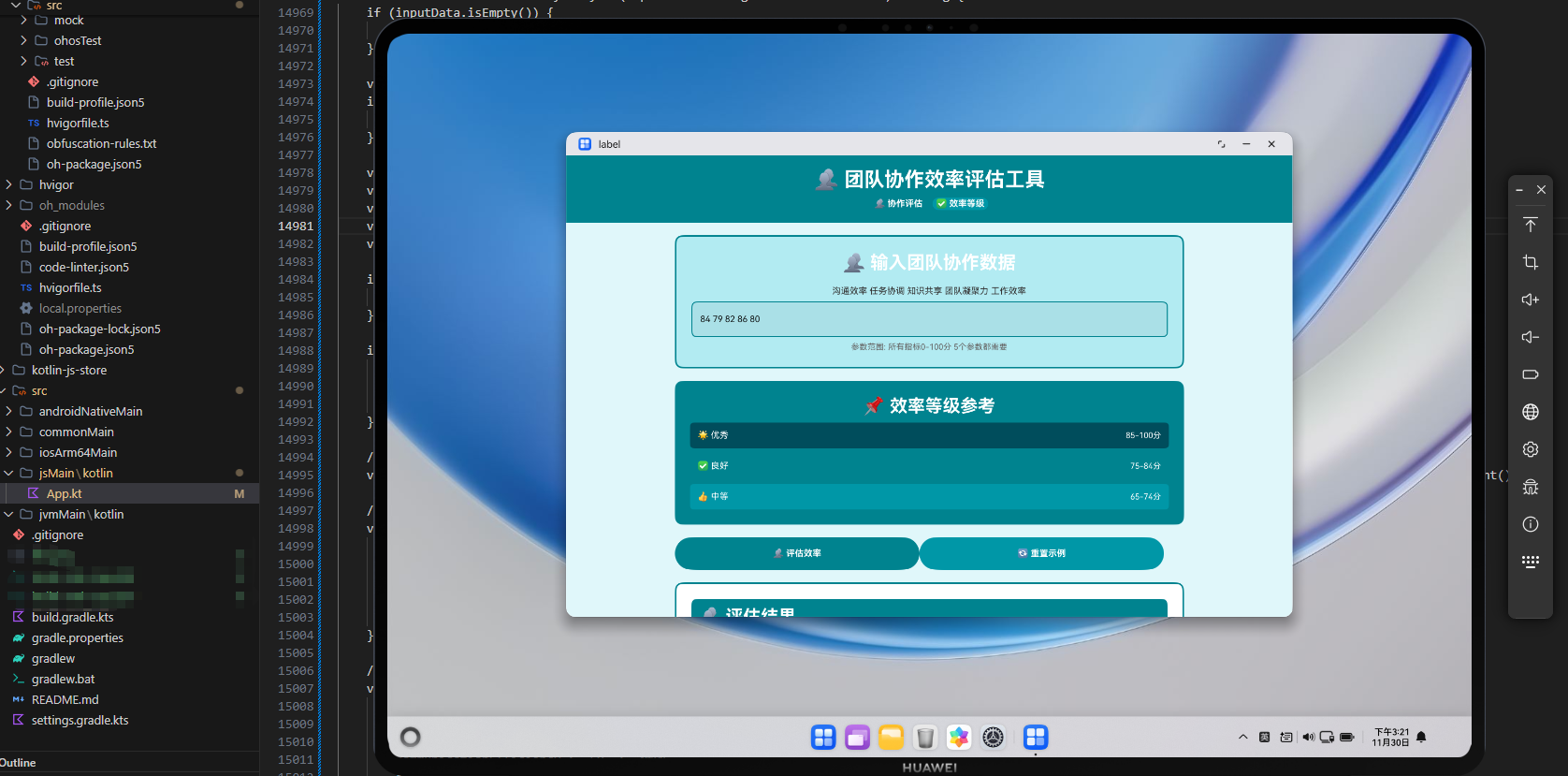
讨论HarmonyOS开发技术,专注于API与组件、DevEco Studio、测试、元服务和应用上架分发等。
更多推荐


 11
11 0
0- 0


 已为社区贡献1条内容

所有评论(0)